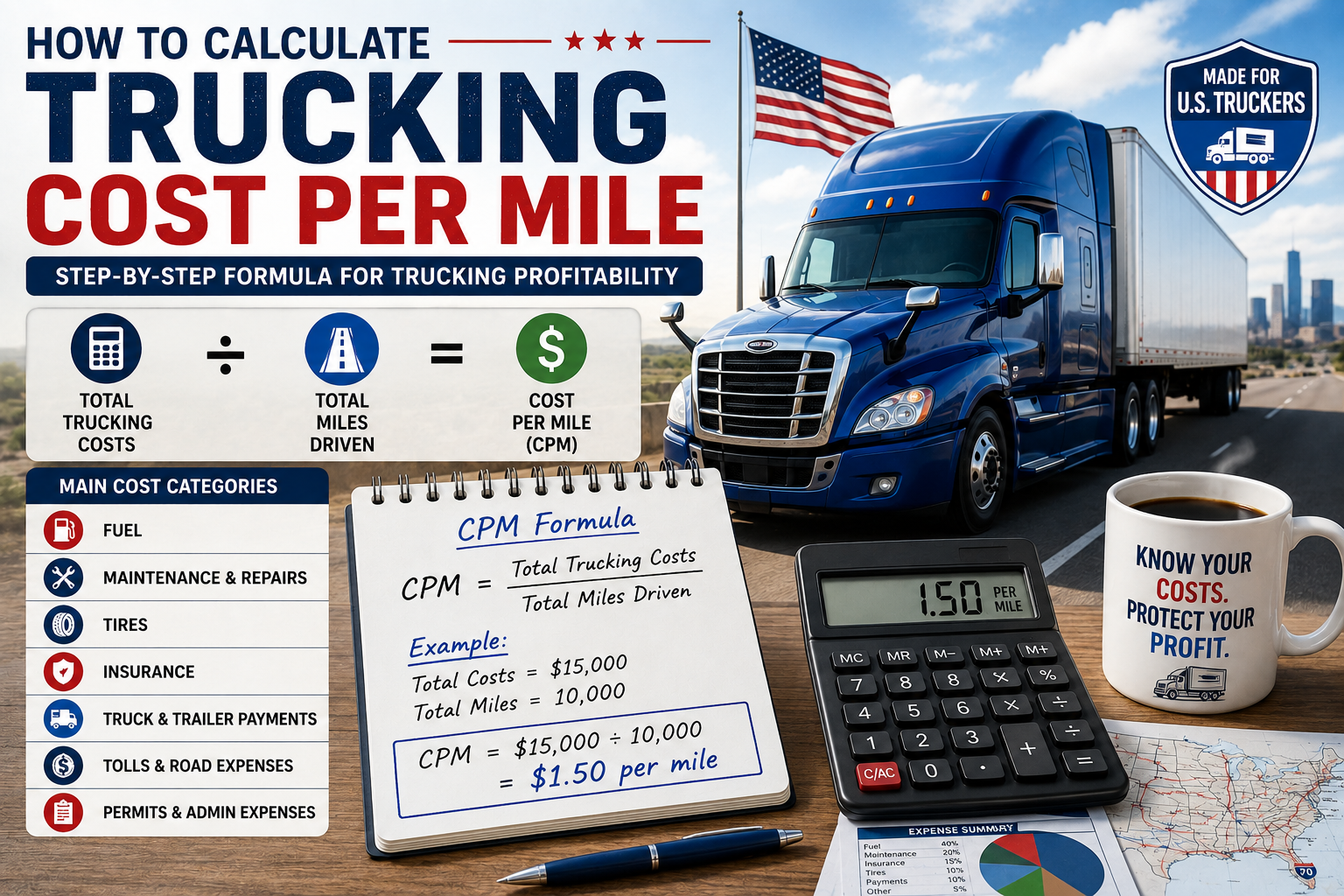
How to Calculate Trucking Cost Per Mile: Step-by-Step Formula for Trucking Profitability
How to Calculate Trucking Cost Per Mile
Knowing how much a load pays is only one part of running a profitable trucking business. The more important question is: How much does it actually cost to move the truck one mile?
That number is your trucking cost per mile, commonly abbreviated as CPM.
For an owner-operator, CPM can help turn everyday expenses into a number that is easier to understand and compare. Instead of looking at fuel receipts, insurance payments, maintenance bills, truck payments, and other expenses separately, you can combine them and determine the cost of operating your truck for every mile driven.
The basic formula is:
Trucking Cost Per Mile = Total Trucking Costs ÷ Total Miles Driven
The calculation becomes more useful when you separate your expenses into fixed costs and variable costs and include both loaded and empty miles. Industry trucking guides commonly use this approach when calculating operating CPM.
What Is Trucking Cost Per Mile?
Trucking cost per mile is the average amount a trucking business spends to operate a truck for each mile driven.
For example, if your business spends $18,000 in total operating costs during a month and the truck travels 10,000 miles during that period:
$18,000 ÷ 10,000 miles = $1.80 per mile
Your trucking cost per mile would therefore be $1.80.
This does not automatically mean you should charge exactly $1.80 per mile. CPM represents your cost. Your required rate also needs to account for profit, taxes and other business considerations.
That distinction is important:
- CPM = what it costs you to operate
- Rate per mile = what you are paid per mile
- Profit per mile = what remains after applicable costs
Understanding these three numbers can make load evaluation and financial planning much easier.
Why Does Cost Per Mile Matter for Owner-Operators?
An owner-operator can generate strong revenue and still struggle financially if operating expenses are not tracked carefully.
A load paying $2.50 per mile might appear attractive at first. But if the actual cost of running the truck is $2.10 per mile, the margin is very different from what the gross rate suggests.
CPM helps answer practical questions such as:
- How much does my truck actually cost to operate?
- Which expenses are increasing my cost per mile?
- Is a particular load likely to cover my costs?
- How much do deadhead miles affect profitability?
- What rate do I need to cover my operating expenses?
- Where can I potentially reduce costs?
- Is my business becoming more or less efficient over time?
For owner-operators, knowing CPM is therefore less about finding one "perfect" number and more about understanding the financial performance of the truck.
Trucking Cost Per Mile Formula
The simplest trucking cost per mile formula is:
CPM = Total Trucking Expenses ÷ Total Miles Driven
To make the calculation more useful, you can break total expenses into fixed and variable costs:
CPM = (Fixed Costs + Variable Costs) ÷ Total Miles Driven
Another useful way to look at the same calculation is:
CPM = Fixed Cost Per Mile + Variable Cost Per Mile
Both approaches can produce the same result when the expenses and mileage are measured over the same period.
Step 1: Determine Your Total Miles
Start with the number of miles your truck actually travels during the period you're analyzing.
You might calculate CPM:
- Monthly
- Quarterly
- Annually
- Per trip
For ongoing business tracking, a monthly calculation can be a useful starting point because it allows you to compare one period with another.
Don't Ignore Empty or Deadhead Miles
One common mistake is calculating costs using only loaded miles.
Suppose your truck travels:
- 8,000 loaded miles
- 2,000 deadhead miles
Your truck actually traveled:
8,000 + 2,000 = 10,000 total miles
Your operating costs were incurred across those 10,000 miles, not just the 8,000 loaded miles.
That is why your CPM calculation should generally account for all miles driven, including empty miles.
Step 2: Calculate Your Fixed Trucking Costs
Fixed expenses are costs that generally do not change directly with every mile driven.
Some common examples include:
- Truck Payment
If you are financing or leasing your truck, your monthly payment is generally considered a fixed operating expense.
- Insurance
Commercial truck insurance can be a significant business expense. Record the amount you actually pay rather than relying on a generic industry estimate.
- Permits and Registration
Depending on your operation, this may include registration, permits and other recurring compliance-related expenses.
- Office and Administrative Costs
Depending on the size of your operation, you may have expenses such as:
- Accounting
- Software
- Phone service
- Dispatch services
- Office expenses
- Bookkeeping
- Trailer Payment
If you finance or lease a trailer, include the applicable payment in your cost calculations.
The exact categories will vary from one trucking operation to another. The important principle is to identify the costs required to keep the business operating.
Step 3: Calculate Your Variable Trucking Expenses
Variable expenses generally change as the truck travels more miles.
Common examples include:
Fuel
Fuel is one of the most important variable expenses to monitor.
Your fuel cost depends on factors such as:
- Diesel price
- Fuel efficiency
- Total miles
- Driving conditions
- Load weight
- Idling
- Route
A small change in fuel efficiency can have a meaningful effect on trucking expenses per mile over thousands of miles.
Maintenance and Repairs
Maintenance expenses can include:
- Oil changes
- Preventive maintenance
- Repairs
- Parts
- Labor
It is useful to track maintenance consistently rather than only recording a major repair when it occurs.
Tires
Tires are another expense that should be included in your operating cost calculations.
Instead of waiting for a large tire bill to appear, you can estimate a maintenance reserve based on your actual operating experience.
Tolls
Tolls can vary significantly depending on routes and the type of operation.
If your business regularly operates on toll roads, include these expenses in your calculation.
Parking and Other Road Expenses
Depending on your operation, you may also have expenses related to:
- Truck parking
- Scales
- Permits
- Road-related fees
- Other trip expenses
The goal is to avoid creating a CPM number that looks low simply because some recurring expenses were left out.
Step 4: Add Fixed and Variable Costs
Once you've listed your expenses, add them together.
For example, imagine an owner-operator has the following monthly costs:
| Expense | Monthly Cost |
|---|---|
| Truck payment | $2,500 |
| Insurance | $1,500 |
| Fuel | $6,000 |
| Maintenance reserve | $1,000 |
| Tires | $500 |
| Tolls and other road expenses | $500 |
| Administrative expenses | $1,000 |
| Total | $13,000 |
If the truck travels 10,000 miles during the month:
$13,000 ÷ 10,000 = $1.30 per mile
The estimated trucking cost per mile is therefore $1.30.
This is an example for understanding the formula, not a benchmark for what every owner-operator should expect. Actual costs vary considerably by truck, mileage, fuel efficiency, insurance, financing, route, maintenance needs and business structure.
Step 5: Calculate Your CPM Trucking Number
Now apply the formula:
CPM = Total Costs ÷ Total Miles
Using the example above:
CPM = $13,000 ÷ 10,000 miles
CPM = $1.30 per mile
This means the operation spent an average of $1.30 for every mile driven during that period.
Tracking this number regularly gives you a much clearer picture than looking at individual expenses in isolation.
Understanding Trucking Expenses Per Mile
You can also calculate individual trucking expenses per mile.
For example, if you spend $6,000 on fuel and drive 10,000 miles:
Fuel cost per mile = $6,000 ÷ 10,000
Fuel cost per mile = $0.60
You can do the same for other categories:
| Expense | Monthly Cost | Miles | Cost Per Mile |
| Fuel | $6,000 | 10,000 | $0.60 |
| Maintenance | $1,000 | 10,000 | $0.10 |
| Insurance | $1,500 | 10,000 | $0.15 |
| Truck payment | $2,500 | 10,000 | $0.25 |
| Other costs | $2,000 | 10,000 | $0.20 |
This approach makes it easier to identify which categories have the biggest impact on your CPM.
Fixed Cost Per Mile vs Variable Cost Per Mile
Understanding the difference between fixed and variable costs is particularly useful when analyzing trucking expenses.
Fixed Cost Per Mile
Fixed costs generally remain relatively stable even if mileage changes.
For example:
Monthly fixed costs = $5,000
Monthly miles = 10,000
Therefore:
$5,000 ÷ 10,000 = $0.50 fixed cost per mile
But if the truck travels 12,500 miles:
$5,000 ÷ 12,500 = $0.40 per mile
The monthly fixed expense did not necessarily change, but its cost per mile decreased because more miles were driven.
Variable Cost Per Mile
Variable costs are more directly associated with vehicle usage.
Fuel, tires and mileage-related maintenance are examples.
If your truck travels more miles, these costs generally increase.
This is why looking only at total monthly expenses isn't enough. Cost per mile provides a way to connect expenses with the amount of work the truck is actually performing.
How CPM Affects Owner-Operator Profitability
Understanding owner-operator profitability requires more than knowing your gross revenue.
Consider a simplified example:
Revenue: $2.50 per mile
Operating cost: $1.70 per mile
The difference is:
$2.50 − $1.70 = $0.80 per mile
If the truck runs 10,000 miles:
$0.80 × 10,000 = $8,000
This simplified example shows why CPM matters.
However, the final profit calculation may require additional considerations such as taxes, personal compensation, financing structure and other business expenses.
Your CPM should therefore be treated as a business management metric, not a guarantee of take-home income.
CPM vs Rate Per Mile: What's the Difference?
These two numbers are often confused.
Rate Per Mile
This is what the customer, broker or shipper pays for the transportation service under the applicable rate structure.
Cost Per Mile
This is what it costs your business to operate the truck.
Profit Per Mile
This is the amount remaining after relevant costs are deducted from revenue.
For example:
Rate = $2.50/mile
CPM = $1.70/mile
Difference = $0.80/mile
That $0.80 is not automatically your final personal income. It is simply the difference between the example revenue and operating cost figures.
How Deadhead Miles Affect Trucking Cost Per Mile
Deadhead miles are miles driven without a revenue-generating load.
They matter because the truck is still consuming fuel, accumulating mileage and contributing to maintenance and other operating expenses.
Imagine a trip has:
- 700 loaded miles
- 300 deadhead miles
The truck travels 1,000 miles, but only 700 miles are loaded.
If the total trip operating cost is $1,500:
$1,500 ÷ 1,000 = $1.50 actual cost per mile
Looking only at the loaded miles would give:
$1,500 ÷ 700 = $2.14
That second figure can be useful for a different type of analysis, but it should not replace your overall operating CPM.
Deadhead should be considered when evaluating the economics of a load or route.
How to Use CPM When Evaluating a Load
Once you know your approximate cost per mile, you can use it as one part of your load evaluation process.
Before accepting a load, consider:
- What is the total revenue?
- How many loaded miles are involved?
- How many deadhead miles will be required?
- What will the fuel expense be?
- What other trip-specific expenses apply?
- Does the expected revenue cover your operating costs?
- Does the load contribute an acceptable margin after costs?
This is more useful than looking at the advertised rate per loaded mile alone.
A load with a higher rate per loaded mile isn't necessarily more profitable if it requires substantial deadhead mileage or has unusually high trip expenses.
Common Mistakes When Calculating CPM
1. Counting Only Fuel
Fuel is important, but it is only one part of the cost structure.
Insurance, truck payments, maintenance, tires, permits, tolls and administrative expenses can also affect the true cost of operating.
2. Ignoring Deadhead Miles
If you calculate your costs using only loaded miles, your operating picture may be distorted.
Track total miles and separately monitor deadhead mileage.
3. Forgetting Irregular Expenses
Some costs don't appear every week or every month.
Examples include major repairs, tire replacement and annual fees.
Creating a reserve or spreading these expenses over an appropriate period can make your CPM more realistic.
4. Using Someone Else's CPM
Another owner-operator's CPM is not necessarily your CPM.
Two trucks can have completely different:
- Financing
- Insurance
- Fuel economy
- Maintenance requirements
- Routes
- Mileage
- Equipment
- Business expenses
Use your own records whenever possible.
5. Calculating CPM From One Unusual Month
A major engine repair or an unusually low-mileage month can make your CPM look unusually high.
Look at trends over several months instead of relying on one isolated number.
How Often Should You Calculate Trucking CPM?
There is no single requirement that every trucking business must follow, but regular tracking is useful.
A practical approach is:
Monthly:
Calculate your current CPM.
Quarterly:
Compare your expense categories and identify trends.
Annually:
Review the overall performance of the business and update assumptions.
You can also calculate CPM for individual trips when you need to understand the economics of a specific load or lane.
The important thing is consistency. A CPM number becomes more useful when you can compare it across similar periods.
How to Reduce Your Cost Per Mile
Once you know your CPM, the next question is usually: Where can I improve it?
Start with your largest expense categories.
- Monitor Fuel Efficiency
Track miles per gallon and fuel spending instead of looking only at the total fuel bill.
- Reduce Unnecessary Deadhead
Better trip planning and stronger backhaul planning can help reduce non-revenue miles.
- Maintain the Truck
Preventive maintenance can help reduce the likelihood of expensive unexpected repairs, although maintenance decisions should always be based on the vehicle manufacturer's requirements and qualified professional advice.
- Track Tire Costs
Monitor tire life, replacement frequency and cost per mile.
- Review Recurring Expenses
Regularly review subscriptions, administrative services and other recurring business costs.
- Compare Your CPM Over Time
The goal isn't necessarily to achieve the lowest possible CPM.
A very low CPM can sometimes mean that an expense has simply been excluded from the calculation.
The better goal is to understand your true operating cost and use that information to make better business decisions.
Frequently Asked Questions About Trucking Cost Per Mile
- How do you calculate trucking cost per mile?
Add your relevant trucking expenses for a specific period and divide the total by the total miles driven during that period.
Formula:
CPM = Total Trucking Costs ÷ Total Miles Driven
For a more detailed calculation, separate fixed and variable expenses before dividing by mileage.
- What expenses should be included in trucking CPM?
Common expenses include fuel, truck payments, insurance, maintenance, tires, tolls, permits, parking and administrative or operating expenses. The exact categories depend on the structure of your trucking business.
- Should deadhead miles be included in CPM?
Yes. If you're calculating your overall operating CPM, include total miles driven, including loaded and deadhead miles. Your truck incurs operating costs during empty miles as well.
- What is the difference between CPM and RPM?
CPM means cost per mile—what it costs to operate the truck per mile.
RPM usually means revenue or rate per mile—what the truck earns per mile under a particular load or revenue calculation.
Comparing the two helps you understand whether revenue is covering operating costs.
- Is a lower CPM always better?
Not necessarily.
A lower CPM can indicate better cost efficiency, but only if the calculation includes the expenses that actually belong in your operating model. Cutting necessary maintenance, for example, may make short-term costs appear lower while creating larger expenses later.
- How can an owner-operator improve profitability?
Start by understanding your true CPM, then compare it with revenue per mile and trip-specific costs. Monitoring fuel efficiency, maintenance, deadhead mileage, recurring expenses and load economics can help identify opportunities to improve margins.
Final Takeaway
Trucking cost per mile is one of the simplest ways to understand the economics of operating a truck.
The core calculation is straightforward:
Trucking Cost Per Mile = Total Trucking Expenses ÷ Total Miles Driven
But the accuracy of the result depends on what you include.
Track fixed expenses, variable expenses, fuel, maintenance, tires, insurance, truck payments and other relevant operating costs. Most importantly, don't forget the miles that don't generate revenue.
Once you know your CPM, you have a clearer starting point for evaluating loads, understanding operating efficiency and assessing owner-operator profitability.
If you want to calculate your own number instead of working through the formula manually, use a truck cost per mile calculator to organize your expenses and mileage into one CPM figure.